Prunes
Serving: 0.25 cup (43.5g, 104 cal)
Key Nutrients
About Prunes
Health benefits
Prunes’ unique antioxidant phytonutrients
The fresh version (plums) and the dried version (prunes) of the plant scientifically known as Prunus domestica have been the subject of repeated health research for their high content of unique phytonutrients called neochlorogenic and chlorogenic acid. These substances found in prunes and plums are classified as phenols, and their function as antioxidants has been well documented. These damage-preventing substances are particularly effective in neutralizing a particularly dangerous oxygen radical called superoxide anion radical, and they have also been shown to help prevent oxygen-based damage to fats. Since our cell membranes, brain cells and molecules such as cholesterol are largely composed of fats, preventing free radical damage to fats is no small benefit.
Normalizing blood sugar levels and helping with weight loss
Prunes’ soluble fiber helps normalize blood sugar levels by slowing the rate at which food leaves the stomach and by delaying the absorption of glucose (the form in which sugar is transported in the blood) following a meal. Soluble fiber also increases insulin sensitivity and can therefore play a helpful role in the prevention and treatment of type 2 diabetes. And, prunes’ soluble fiber promotes a sense of satisfied fullness after a meal by slowing the rate at which food leaves the stomach, so prunes can also help prevent overeating and weight gain.
Prunes’ fiber for regularity, lower cholesterol, & intestinal protection
Prunes are well known for their ability to prevent constipation. In addition to providing bulk and decreasing the transit time of fecal matter, thus decreasing the risk of colon cancer and hemorrhoids, prunes’ insoluble fiber also provides food for the “friendly” bacteria in the large intestine. When these helpful bacteria ferment prunes’ insoluble fiber, they produce a short-chain fatty acid called butyric acid, which serves as the primary fuel for the cells of the large intestine and helps maintain a healthy colon. These helpful bacteria also create two other short-chain fatty acids, propionic and acetic acid, which are used as fuel by the cells of the liver and muscles.
The propionic acid produced from prunes’ insoluble fiber may also be partly responsible for the cholesterol-lowering properties of fiber. In animal studies, propionic acid has been shown to inhibit HMG-CoA reductase, an enzyme involved in the production of cholesterol by the liver. By lowering the activity of this enzyme, propionic acid helps lower blood cholesterol levels.
In addition, prunes’ soluble fibers help to lower cholesterol by binding to bile acids and removing them from the body via the feces. Bile acids are compounds used to digest fat that are manufactured by the liver from cholesterol. When they are excreted along with prunes’ fiber, the liver must manufacture new bile acids and uses up more cholesterol, thus lowering the amount of cholesterol in circulation. Soluble fiber may also reduce the amount of cholesterol manufactured by the liver.
A study published in the Archives of Internal Medicine confirms that eating high fiber foods, such as prunes, helps prevent heart disease. Almost 10,000 American adults participated in this study and were followed for 19 years. People eating the most fiber, 21 grams per day, had 12% less coronary heart disease (CHD) and 11% less cardiovascular disease (CVD) compared to those eating the least, 5 grams daily. Those eating the most water-soluble dietary fiber fared even better with a 15% reduction in risk of CHD and a 10% risk reduction in CVD.
Lastly, the insoluble fiber provided by prunes feed friendly bacteria in the digestive tract, which helps to maintain larger populations of friendly bacteria. In addition to producing the helpful short-chain fatty acids described above, friendly bacteria play an important protective role by crowding out pathogenic (disease-causing) bacteria and preventing them from surviving in the intestinal tract.
Fruit and cereal fiber protective against postmenopausal breast cancer
Results of a prospective study involving 51,823 postmenopausal women for an average of 8.3 years showed a 34% reduction in breast cancer risk for those consuming the most fruit fiber compared to those consuming the least. In addition, in the subgroup of women who had ever used hormone replacement, those consuming the most fiber, especially cereal fiber, had a 50% reduction in their risk of breast cancer compared to those consuming the least. Int J Cancer. 2008 Jan 15;122(2):403-12.
Fruits richest in fiber include apples, dates, figs, pears and prunes. When choosing a high fiber cereal, look for whole grain cereals as they supply the most bran (a mere 1/3rd cup of bran contains about 14 grams of fiber).
Iron absorption
The ability of plum and prune to increase absorption of iron into the body has also been documented in published research.
Description
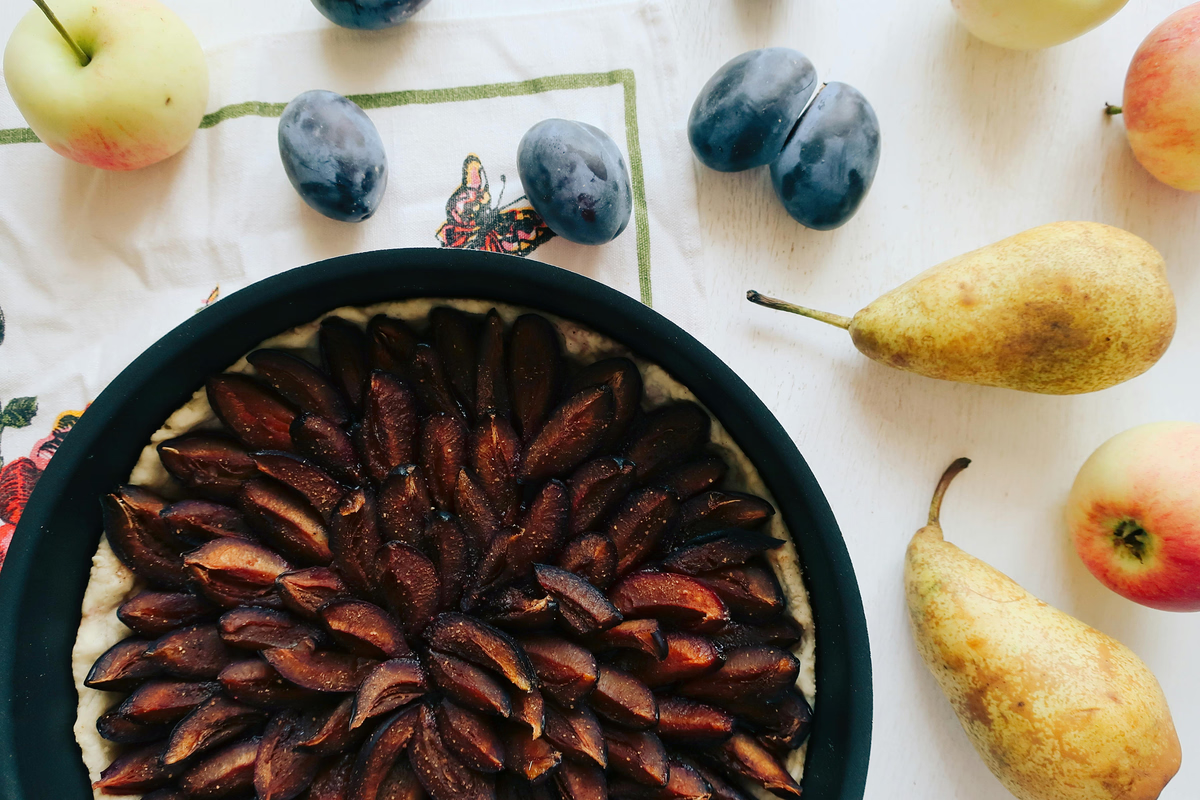
Prunes are nutritious fruits that are extremely fun to eat since they have a sweet, deep taste and a sticky, chewy texture. Prunes are actually dried plums, more specifically the dried version of European plums, including the Agen variety.
The prune has been rebranded commercially as the “dried plum,” an effort to move past the fruit’s traditional association with digestive regularity and highlight its broader nutrient profile.
The scientific name for plums and prunes is Prunus domestica.
History
The process of drying plums to make prunes is thought to have originated thousands of years ago in an area near the Caspian Sea, the same region where the prune-producing European plums originated. They spread throughout Europe with the migration of different cultures and civilizations.
The process of drying plums to produce prunes took hold in California, now the leading producer of prunes worldwide, in the mid-19th century when Louis Pellier planted grafted plum tree cuttings brought back with him from his native France. Among these trees were those belonging to the Agen variety, the type of plum that is extremely well suited to be dried to make prunes.
How to select and store
Prunes are sold either with their pits or already pitted. The form you choose should depend upon your personal preference and recipe needs.
Ideally, you should purchase prunes that are sold in transparent containers so that you can evaluate them for quality. They should be plump, shiny, relatively soft and free of mold. If the packages are opaque, ensure that they are tightly sealed so that the prunes will not have lost any moisture. As with any other dried fruit, try to purchase prunes that are not processed with food preservatives such as sulfites.
Prunes should be stored in an airtight container in a cool, dry and dark place where they will keep for several months. Storing them in the refrigerator will extend their freshness, allowing them to keep for about six months. Regardless of where you store them, make sure that when you open the container, you reseal it tightly to prevent the prunes from losing moisture.
Tips for preparing and cooking
Preparation
If you have prunes that are extremely dry, soaking them in hot water for a few minutes will help to refresh them. If you are planning on cooking the prunes, soaking them in water or juice beforehand will reduce the cooking time.
How to enjoy
Serving ideas
- Serve stewed prunes with rosemary-scented braised lamb and enjoy this Middle Eastern inspired meal.
- Serve stewed or soaked prunes on top of pancakes and waffles.
- Combine diced dried prunes with other dried fruits and nuts to make homemade trail mix.
- Prunes make a delicious addition to poultry stuffing.
For more recipe ideas, see Recipes.
Individual concerns
Prunes and oxalates
Prunes are among a small number of foods that contain measurable amounts of oxalates, naturally-occurring substances found in plants, animals, and human beings. When oxalates become too concentrated in body fluids, they can crystallize and cause health problems. For this reason, individuals with already existing and untreated kidney or gallbladder problems may want to avoid eating prunes. Laboratory studies have shown that oxalates may also interfere with absorption of calcium from the body. Yet, in peer-reviewed research, the ability of oxalates to lower calcium absorption is relatively small and definitely does not outweigh the ability of oxalate-containing foods to contribute calcium to the meal plan. If your digestive tract is healthy, and you do a good job of chewing and relaxing while you enjoy your meals, you will get significant benefits, including calcium absorption, from calcium-rich plant foods that also contain oxalic acid. Ordinarily, a healthcare practitioner would not discourage a person focused on ensuring that they are meeting their calcium requirements from eating these nutrient-rich foods because of their oxalate content. For more on this subject, please see “Can you tell me what oxalates are and in which foods they can be found?”
Nutritional profile
A quarter-cup (43.5g) of prunes provides 28.8% DV of vitamin K, 13.3% DV of copper, 12.4% DV of fiber, and 318 mg of potassium (9.1% DV).
For an in-depth nutritional profile click here: Prunes.
For roasting vegetables, a ceramic baking dish like the Staub Ceramic Baking Dish Set retains heat beautifully and goes straight from oven to table.
Recipes with Prunes
No recipes found.
Full Nutrient Profile
Related Articles
References
- Ballot D, Baynes RD, Bothwell TH, et al. The effects of fruit juices and fruits on the absorption of iron from a rice meal. Br J Nutr 1987 May;57(3):331-43. 1987. PMID:13550. https://doi.org/10.1515/znc-1976-11-1217
- Bazzano LA, He J, Ogden LG, Loria CM, Whelton PK. Dietary fiber intake and reduced risk of coronary heart disease in US men and women: the National Health and Nutrition Examination Survey I Epidemiologic Follow-up Study. Arch Intern Med. 2003 Sep 8;163(16):1897-904. 2003. https://doi.org/10.1016/s0140-6736(12)61766-8
- Bhatia IS, Bajaj KL. Tannins in black-plum (Syzygium cumini L.) seeds. Biochem J 1972 Jun;128(1):56P. 1972. PMID:13560.
- Cho E, Seddon JM, Rosner B, Willett WC, Hankinson SE. Prospective study of intake of fruits, vegetables, vitamins, and carotenoids and risk of age-related maculopathy. Arch Ophthalmol. 2004 Jun;122(6):883-92. 2004. PMID:15197064. https://doi.org/10.1001/archopht.122.6.883
- Egbekun MK, Akowe JI, Ede RJ. Physico-chemical and sensory properties of formulated syrup from black plum (Vitex doniana) fruit. Plant Foods Hum Nutr 1996 Jun;49(4):301-6. 1996. PMID:13540.
- Ensminger AH, Ensminger, ME, Kondale JE, Robson JRK. Foods & Nutriton Encyclopedia. Pegus Press, Clovis, California. 1983.
- Ensminger AH, Esminger M. K. J. e. al. Food for Health: A Nutrition Encyclopedia. Clovis, California: Pegus Press; 1986. 1986. PMID:15210.
- Fortin, Francois, Editorial Director. The Visual Foods Encyclopedia. Macmillan, New York. 1996.
- Nakatani N, Kayano S, Kikuzaki H, et al. Identification, quantitative determination, and antioxidative activities of chlorogenic acid isomers in prune (Prunus domestica L. ). J Agric Food Chem 2000 Nov;48(11):5512-6. 2000. PMID:13580.
- Sellmeyer DE, Schloetter DE, Schloetter M et al. Potassium citrate prevents urine calcium excretion and bone resorption induced by a high sodium chloride diet. J Clin Endo Metab 2002;87(5):2008-12. 2002. https://doi.org/10.1210/jcem.87.5.8470
- Stacewicz-Sapuntzakis M, Bowen PE, Hussain EA, et al. Chemical composition and potential health effects of prunes: a functional food?. Crit Rev Food Sci Nutr 2001 May;41(4):251-86. 2001. PMID:13590.
- Suzuki R, Rylander-Rudqvist T, Ye W, et al. Dietary fiber intake and risk of postmenopausal breast cancer defined by estrogen and progesterone receptor status--a prospective cohort study among Swedish women. Int J Cancer. 2008 Jan 15;122(2):403-12. 2008. PMID:17764112. https://doi.org/10.1002/ijc.23060
- Wood, Rebecca. The Whole Foods Encyclopedia. New York, NY: Prentice-Hall Press; 1988. 1988. PMID:15220. https://doi.org/10.1002/food.19770210206
- Stacewicz-Sapuntzakis M, Bowen PE, Hussain EA, et al. Chemical composition and potential health effects of prunes: a functional food. Crit Rev Food Sci Nutr 2001 May;41(4):251-86 2001. PMID:13590.