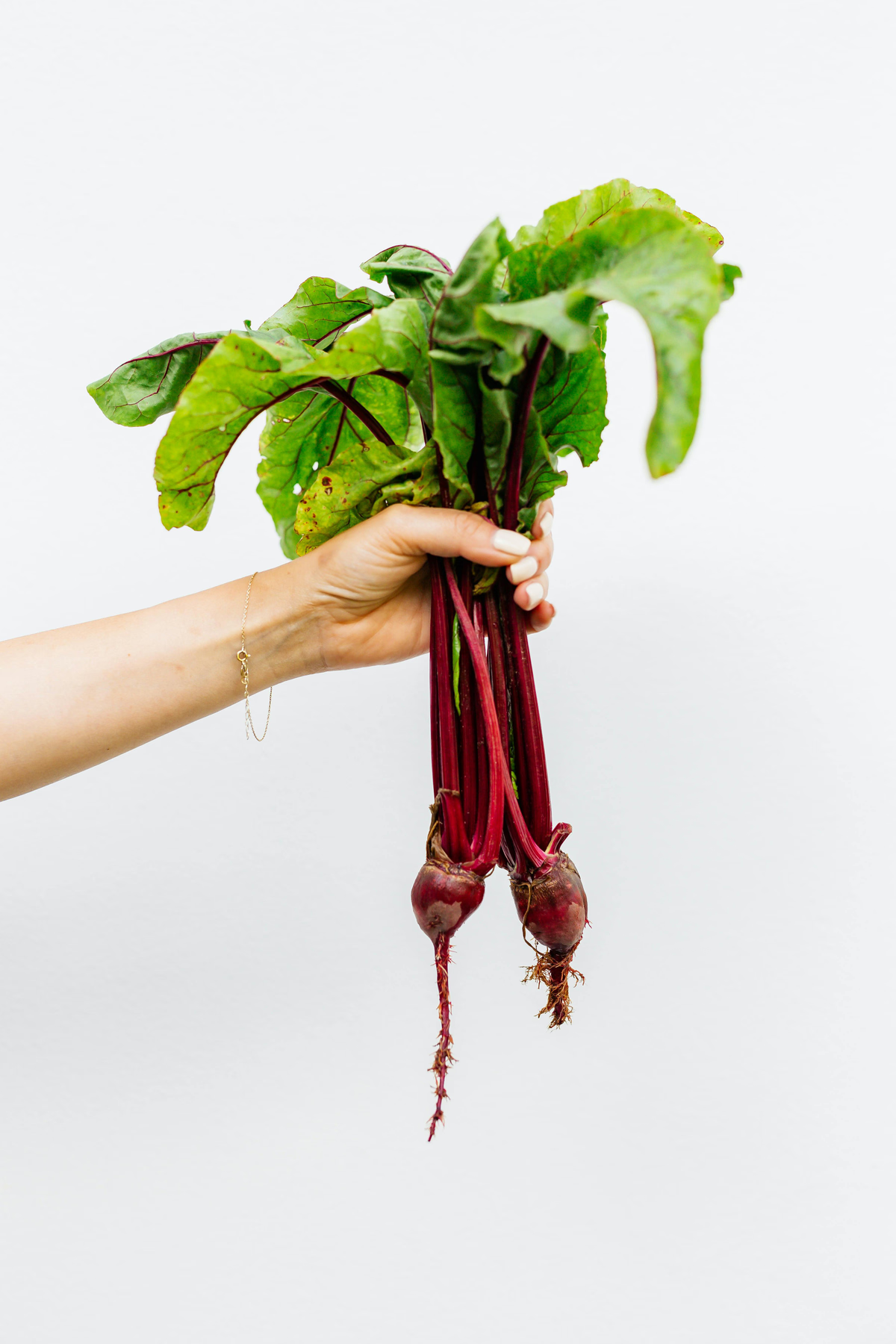
Beet greens
Serving: 1.00 cup (144g, 39 cal)
Key Nutrients
| Nutrient | Amount | DV% | Rating |
|---|---|---|---|
| vitamin K | 696.96 mcg | 774% | Excellent |
| vitamin A | 551.09 mcg RAE | 61% | Excellent |
| vitamin C | 35.86 mg | 48% | Excellent |
| copper | 0.36 mg | 40% | Excellent |
| vitamin B2 | 0.42 mg | 32% | Excellent |
| manganese | 0.74 mg | 32% | Excellent |
| potassium | 1308.96 mg | 28% | Excellent |
| magnesium | 97.92 mg | 23% | Excellent |
| vitamin E | 2.61 mg (ATE) | 17% | Excellent |
| calcium | 164.16 mg | 16% | Excellent |
| iron | 2.74 mg | 15% | Very Good |
| fiber | 4.18 g | 15% | Very Good |
| vitamin B1 | 0.17 mg | 14% | Very Good |
| vitamin B6 | 0.19 mg | 11% | Very Good |
| pantothenic acid | 0.47 mg | 9% | Very Good |
| phosphorus | 59.04 mg | 8% | Very Good |
| protein | 3.7 g | 7% | Very Good |
| zinc | 0.72 mg | 7% | Good |
| folate | 20.16 mcg | 5% | Good |
| vitamin B3 | 0.72 mg | 5% | Good |
vitamin K
Excellentvitamin A
Excellentvitamin C
Excellentcopper
Excellentvitamin B2
Excellentmanganese
Excellentpotassium
Excellentmagnesium
Excellentvitamin E
Excellentcalcium
Excellentiron
Very Goodfiber
Very Goodvitamin B1
Very Goodvitamin B6
Very Goodpantothenic acid
Very Goodphosphorus
Very Goodprotein
Very Goodzinc
Goodfolate
Goodvitamin B3
GoodAbout Beet greens
What’s new and beneficial about beet greens
- A Chilean dietary study ranked beet greens among the top 10 food contributors to iron intake nationally. While legumes (led by pinto beans) were the most important food group for iron, beet greens stood out within the vegetable category, providing 15% DV of iron per 1-cup cooked serving.
- Dark green leafy vegetables (DGLV) are often lumped together as a group and treated interchangeably. However, up-to-date nutrient information reveals important differences between members of this incredibly nutrient-rich food group. For example, when beet greens are compared with two other common DGLVs—turnip greens and mustard greens—only beet greens provide excellent amounts of both calcium and magnesium, While all three of these DGLVs provide excellent amounts of calcium, only beet greens also provide an excellent amount of magnesium at 98 milligrams per serving, or nearly 25% of the recommended daily amount. This unique aspect of beet greens gives them a calcium:magnesium ratio of 1.6:1, in comparison to the ratio in turnip greens of 6.2:1, or the ratio in mustard greens of 9.2:1.
- Both beet greens and beet roots can provide you with outstanding nourishment. The roots are especially concentrated in folate, providing 5-6 times the amount of this vitamin as the leaves. However, from an overall nutritional perspective, beet greens achieve 11 rankings of excellent, 6 rankings of very good, and 3 rankings of good in our WHF rating system, for a total of 20 rankings. (By comparison, beet roots achieve a total of 10 rankings.) This outcome places beet greens in our Top 10 foods in terms of total rankings.
- A recent study has shown beet greens to be a major contributor in many diets to total intake of the carotenoids lutein and beta-carotene. While not as concentrated in lutein as collard greens or spinach, beet greens have nevertheless been shown to be an outstanding source of this key carotenoid. (Lutein is known to play an especially important role in eye health, including the health of the retina.)
Recommendations
Foods belonging to the chenopod family—including beets, chard, spinach and quinoa—continue to show an increasing number of health benefits not readily available from other food families. The red and yellow betalain pigments found in this food family, their unique epoxyxanthophyll carotenoids, and the special connection between their overall phytonutrients and our nervous system health (including our specialized nervous system organs like the eye) point to the chenopod family of foods as unique in their health value. While we have yet to see large-scale human studies that point to a recommended minimum intake level for foods from this botanical family, we have seen data on chenopod phytonutrients, and based on this data, we recommend that you include foods from the chenopod family in your diet 1-2 times per week. In the case of a leafy food like spinach, we recommend a serving size of at least 1/2 cup, and even more beneficial, at least one full cup. In the case of a root food like beet root, we recommend a serving size of at least 1/2 whole medium beet, and even more beneficial, at least 1 whole medium beet. For quinoa, our recommended minimum serving size is 1/2 cup pre-cooked.
Beet Greens, boiled
1.00 cup
(144.00 grams)
Calories: 39
GI: not available
NutrientDRI/DV
vitamin K774%
vitamin A61%
vitamin C48%
copper40%
vitamin B232%
manganese32%
potassium28%
magnesium23%
vitamin E17%
calcium16%
fiber15%
iron15%
vitamin B114%
vitamin B611%
pantothenic acid9%
phosphorus8%
protein7%
zinc7%
vitamin B35%
folate5%
- Health Benefits
- Description
- History
- How to Select and Store
- Tips for Preparing and Cooking
- How to Enjoy
- Individual Concerns
- Nutritional Profile
- References
Health benefits
Unusually comprehensive nourishment of beet greens
Beet greens achieve 20 nutrient rankings across the categories of excellent, very good, and good. One cup (144g) cooked provides vitamin K (774% DV), vitamin A (61% DV), vitamin C (48% DV), copper (40% DV), vitamin B2 (32% DV), manganese (32% DV), potassium (28% DV), and magnesium (23% DV at 98 mg per serving), along with calcium, fiber, and iron.
Among common dark green leafy vegetables, beet greens provide concentrated amounts of both calcium and magnesium, yielding a calcium:magnesium ratio of 1.6:1. By comparison, turnip greens have a ratio of 6.2:1 and mustard greens 9.2:1. Given that magnesium deficiency is more prevalent than calcium deficiency among U.S. adults, this balanced ratio is noteworthy.
In the phytonutrient category, beet greens show special benefits in the area of carotenoid richness. We rank them as an excellent source of vitamin A due to their rich concentration of beta-carotene and lutein. Beet greens have been shown to be a major contributor in many diets to total intake of the carotenoids lutein and beta-carotene. While not as concentrated in lutein as collard greens or spinach, beet greens have nevertheless been shown to be an outstanding source of this key carotenoid. Lutein is known to play an especially important role in eye health, including the health of the retina.
Other health benefits of beet greens
Few studies have isolated the health effects of beet greens from dark green leafy vegetables (DGLVs) as a broader category. Increased DGLV intake is associated in large-scale epidemiologic studies with lower risk of type 2 diabetes, hypertension, cardiovascular disease, and stroke. The World Cancer Research Fund and American Institute for Cancer Research (WCRF/AICR) report also suggests decreased risk of certain cancers with generous DGLV intake. Studies specifically analyzing beet green consumption are still needed.
Description
Both beets and Swiss chard are different varieties within the same plant family (Amaranthaceae-Chenopodiaceae) and their edible leaves share a resemblance in both taste and texture. All varieties of table beets have edible leaves that are primarily green in color. However, the veins in these beet greens tend to take on the color of the beet root. For this reason, you will find beet greens from yellow beets with vibrant yellow veins, beet greens from red beets having rich red veins, and beet greens from white beets with distinct white veins. Each of these greens can make an outstanding contribution to your health.
The similarity between beets greens and Swiss chard does not stop with their plant family, taste, or texture. At WHF, we use a quick boil for both foods to help preserve their nutrient richness during cooking. In addition, both foods achieve of 20 rankings of excellent, very good, or good in our rating system!
The science name for the beet plant is Beta vulgaris. There are several subspecies of beets within this scientific category, including the subspecies vulgaris, macrocarpa, crassa, and maritime. The greens attached to the beet roots are delicious and can be prepared like spinach or Swiss chard. They are incredibly rich in nutrients, concentrated in vitamins and minerals as well as carotenoids such as beta-carotene and lutein/zeaxanthin.
While beets are available throughout the year, their season runs from June through October when the youngest, most tender beets are easiest to find.
History
Beet greens have been enjoyed in cuisines worldwide since prehistoric times, especially in Northern Africa, Asia, and parts of Europe. Today, of course, they are enjoyed worldwide.
From a commercial production standpoint, beets fall into three basic categories: table beets, which are grown primarily for consumption as fresh vegetables; sugar beets, which are grown primarily for the extraction of beet sugar; and fodder beets, which are grown primarily for use in animal feed. From a practical standpoint, one of the key differences that has emerged between sugar beets and table beets involves the role of genetic engineering. The vast majority of all sugar beets grown worldwide involve genetically modified versions of the plants. This extensive use of genetic engineering does not exist to the same degree for table beets, and organic table beets (and beet greens) are widely available in the marketplace with USDA certification as having been grown from seeds that have not been genetically engineered. It is also worth noting here that when used as feed for the raising of animals providing certified organic meats, milks, cheeses, and other foods, fodder beets must be organically grown.
Sugar beets far outstrip table beets in terms of U.S. production as well as production worldwide. Approximately 30 million tons of sugar beets are grown and harvested in the U.S. each year, with Minnesota, North Dakota, and Idaho producing the greatest volume. Worldwide, sugar beet production production averages close to 300 million tons, with the Russian Federation, France, United States, and Germany among the leading sugar beet producers. On a global basis, over 12,500,000 acres of sugar beets are plants each year. In the U.S. approximately 1,250,000 acres of sugar beets are planted each year, By comparison, only 700 acres are planted in the production of U.S. table beets.
How to select and store
Beet Greens are available throughout the garden season. Here are a few things to look for when selecting fresh beet greens:
When choosing beet greens that comes attached to the roots, choose smaller beet roots over larger, tougher ones. Beets over 2-1/2 inches in diameter may be tough and have a woody core. Pass over any beet roots that are cracked, soft, bruised, or shriveled, or look very dry. Avoid elongated beets with round, scaly areas around the top surface. These beets will be tough, fibrous, and strongly flavored.
If the beet greens are still attached to the root, they should be crisp looking and not wilted or slimy. They should appear fresh, tender, and have a lively green color.
At WHF, we encourage the purchase of certified organically grown foods, and beets (and their accompanying greens) are no exception. Repeated research studies on organic foods as a group show that your likelihood of exposure to contaminants such as pesticides and heavy metals can be greatly reduced through the purchased of certified organic foods, including beet greens. In many cases, you may be able to find a local organic grower who sells beets but has not applied for formal organic certification either through the U.S. Department of Agriculture (USDA) or through a state agency. (Examples of states offering state-certified organic foods include California, New York, Oregon, Vermont, and Washington.) However, if you are shopping in a large supermarket, your most reliable source of organically grown beets is very likely to be beets that display the USDA organic logo.
Cut the majority of the greens and their stems from the beet roots. Store the unwashed greens in a separate plastic bag squeezing out as much of the air as possible. Place in refrigerator where they will keep fresh for about four days.
Here is some background on why we recommend refrigerating beet greens. Whenever food is stored, four basic factors affect its nutrient composition: exposure to air, exposure to light, exposure to heat, and length of time in storage. Vitamin C, vitamin B6, and carotenoids are good examples of nutrients highly susceptible to heat, and for this reason, their loss from food is very likely to be slowed down through refrigeration.
Tips for preparing and cooking
Preparation
If Beet Greens are still attached to the beet root, cut leaves off at the stem where the leafy portion ends; the portion of the stem between the leaf and the root is too tough to enjoy. Rinse the leaves under cold running water and cut into ½” slices. Do not soak the leaves in the water as water-soluble nutrients will leach into the water.
Cooking for nutrient retention
Beet greens are only one of three vegetables we recommend Quick Boiling to free up acids and allow them to leach into the boiling water; this brings out a sweeter taste from the beet greens. Discard the boiling water after cooking; do not drink it or use it for stock because of its acid content.
Quick Boiling—similar to Quick Steaming and Healthy Sauté, our other recommended cooking methods—follows three basic cooking guidelines that are generally associated in food science research with improved nutrient retention. These three guidelines are: (1) minimal necessary heat exposure; (2) minimal necessary cooking duration; (3) minimal necessary food surface contact with cooking liquid.
Use a large pot (3 quart) with lots of water and bring to a rapid boil. Add beet greens to the boiling water and boil for 1 minute. Begin timing as soon as you place the beet greens in the pot if you are using 1 pound or less of beet greens. If you are cooking larger quantities of beet greens bring the water back to a boil before beginning timing the 1 minute. Do not cover the pot when cooking beet greens. Leaving the pot uncovered helps to release more of the acids with the rising steam. Research has shown that the boiling of beet greens in large amounts of water helps decrease the oxalic acid content.
Remove beet greens from pot, press out liquid with a fork, place in a bowl, toss with our Mediterranean Dressing, and top with your favorite optional ingredients. Beet Greens are prepared in the same way as spinach. For details, see 1-Minute Spinach.
How to enjoy
Serving ideas
- Add layers of beet greens to your next lasagna recipe.
- Pine nuts are a great addition to cooked beet greens..
Recipes that feature beet greens
You can substitute the spinach in any of the spinach recipes with beet greens:
- Poached Eggs over Spinach
- Poached Eggs over Spinach & Mushrooms
- Mediterranean Baby Spinach Salad
- Warm Spinach Salad with Tuna
- Indian-Style Lentils
- 1-Minute Spinach
- Golden Spinach and Sweet Potato Healthy Sauté
Individual concerns
Oxalate content
Beet greens have consistently been determined to have high oxalate content. Oxalates are naturally occurring organic acids found in a wide variety of foods, and in the case of certain medical conditions, they must be greatly restricted in a meal plan to prevent over-accumulation inside the body. Our comprehensive article about oxalates will provide you with practical and detailed information about these organic acids, food, and health.
Nutritional profile
Beet greens rank among the most nutrient-dense vegetables per calorie. One cup cooked (144g, 39 calories) provides concentrated amounts of vitamins K, A (as carotenoids), C, B2, E, and B1, along with copper, potassium, manganese, magnesium, calcium, iron, phosphorus, and protein. They also supply zinc, folate, and vitamin B3.
A quality salad spinner like the OXO Good Grips Salad Spinner removes excess water quickly, which helps leafy greens cook evenly and keeps salads crisp.
Recipes with Beet greens
- 1-Minute "Quick Boiled" Spinach
- Poached Eggs over Spinach
- Poached Eggs over Spinach & Mushrooms
- Warm Spinach Salad with Tuna
- Indian-Style Lentils
- Golden Spinach and Sweet Potato Healthy Sauté
- Mediterranean Dressing
- Garlic Dip
- 7-Minute "Quick Steamed" Butternut Squash
- 5-Minute "Quick Steamed" Brussels Sprouts
- 3-Minute "Healthy Sautéed" Green Peas
Full Nutrient Profile
Related Articles
- Adapting a Meal Plan for Little or No Grains
- Can you tell me about oxalates, including the foods that contain them and how are they related to nutrition and health?
- Eating in Season: Your Need-to-Know Basics
- I've heard a lot about eating a "colorful diet." Should I pick fruits and vegetables based on color to help me get more benefits from these foods?
- Veggie Advisor: Why are Vegetables So Indispensable for Healthy Eating?
- Which foods contain chlorophyll, and in what amount?
References
- Carter P, Gray LJ, Troughton J, et al. Fruit and vegetable intake and incidence of type 2 diabetes mellitus: systematic review and meta-analysis. BMJ. 2010 Aug 18;341:c4229. doi: 10.1136/bmj.c4229. https://doi.org/10.1136/bmj.c4229
- Freidig AK and Goldman IL. Variation in Oxalic Acid Content among Commercial Table Beet Cultivars and Related Crops. Journal of the American Society for Horticultural Science JASHS January 2011 vol. 136 no. 1, pages 54-60. https://doi.org/10.21273/jashs.136.1.54
- He FJ, Nowson CA, Lucas M, MacGregor GA. Increased consumption of fruit and vegetables is related to a reduced risk of coronary heart disease: meta-analysis of cohort studies. J Hum Hypertens. 2007; 21:717—28. https://doi.org/10.1038/sj.jhh.1002212
- Hung HC, Joshipura KJ, Jiang R, et al. Fruit and vegetable intake and risk of major chronic disease. J Natl Cancer Inst. 2004; 96:1577—84. https://doi.org/10.1093/jnci/djh296
- Lucarini M, Lanzi S, D'Evoli L et al. Intake of vitamin A and carotenoids from the Italian population--results of an Italian total diet study. Int J Vitam Nutr Res. 2006 May;76(3):103-9. https://doi.org/10.1024/0300-9831.76.3.103
- Norat T, Aune D, Chan D, et al. Fruits and vegetables: updating the epidemiologic evidence for the WCRF/AICR lifestyle recommendations for cancer prevention. https://doi.org/10.1007/978-3-642-38007-5_3
- Cancer Treat Res. 2014;159:35-50.
- Olivares M, Pizarro F, de Pablo S, et al. Iron, zinc, and copper: contents in common Chilean foods and daily intakes in Santiago, Chile. Nutrition, Volume 20, Issue 2, February 2004, Pages 205-212. https://doi.org/10.1016/j.nut.2003.11.021
- Pennington JAT and Fisher RA. Food component profiles for fruit and vegetable subgroups. Journal of Food Composition and Analysis, Volume 23, Issue 5, August 2010, Pages 411-418. https://doi.org/10.1016/j.jfca.2010.01.008
- Rao AV and Rao LG. Carotenoids and human health. Pharmacological Research, Volume 55, Issue 3, March 2007, Pages 207-216. https://doi.org/10.1016/j.phrs.2007.01.012
- Simpson TS, Savage GP, Sherlock R, et al. Oxalate content of silver beet leaves (Beta vulgaris var. cicla) at different stages of maturation and the effect of cooking with different milk sources. J Agric Food Chem. 2009 Nov 25;57(22):10804-8. doi: 10.1021/jf902124w. https://doi.org/10.1021/jf902124w
- Song W, Derito CM, Liu MK et al. Cellular antioxidant activity of common vegetables. J Agric Food Chem. 2010 Jun 9;58(11):6621-9. https://doi.org/10.1021/jf9035832
- Titchenal CA and Dobbs J. A system to assess the quality of food sources of calcium. https://doi.org/10.1016/j.jfca.2006.04.013
- Journal of Food Composition and Analysis, Volume 20, Issue 8, December 2007, Pages 717-724.
- van Jaarsveld P, Faber M, van Heerden I, et al. Nutrient content of eight African leafy vegetables and their potential contribution to dietary reference intakes. Journal of Food Composition and Analysis, Volume 33, Issue 1, February 2014, Pages 77-84. https://doi.org/10.1016/j.jfca.2013.11.003
- Wang C, Riedl KM, Schwartz SJ etl al. Fate of folates during vegetable juice processing — Deglutamylation and interconversion. Food Research International, Volume 53, Issue 1, August 2013, Pages 440-448.